
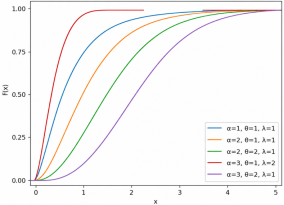
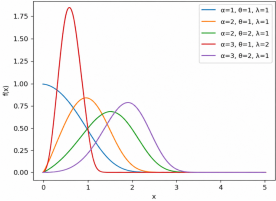
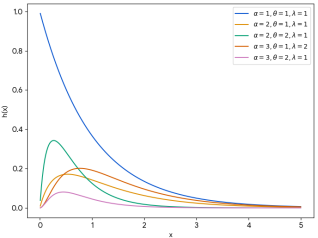
Researchers have developed various models to analyze and assess lifetime data sets across different fields. The need for more applicable and flexible models is highlighted, and statistical distributions emerge as the key to understanding and interpreting these real-world events. However, in many practical situations, these standard distributions do not adequately fit real-life data. As a result, there is a need to develop and modify distributions to increase their flexibility. Statisticians have responded to this need by proposing new families of distributions that extend well-known standard distributions by adding one or more parameters. In this study, a new continuous probability distribution Exponential-Gamma Exponential (EGE) distribution was introduced and investigated. The model was constructed by compounding the exponential baseline distribution with a gamma-generated transformation in order to improve flexibility in modelling complex lifetime and survival data. Many real-world datasets in reliability engineering, biomedical sciences, finance, and hydrology exhibit skewness, heavy tails, and non-monotonic hazard rate behaviours, which are not adequately captured by classical exponential models. The proposed distribution incorporates additional shape parameters that allow greater control over distributional form and hazard behaviour. The statistical properties of the EGE distribution were derived, including the probability density function, cumulative distribution function, survival function, hazard rate function, quantile function, raw moments, mean, variance, coefficient of variation, skewness, kurtosis, moment generating function, characteristic function, Rényi entropy, and maximum likelihood estimation was used to estimate the parameter of the new distribution. The results show that the proposed model is flexible and extends the classical exponential distribution while maintaining analytical tractability. The model can be useful for analyzing lifetime and reliability data, especially in situations involving varying hazard rates and complex data structures.
| Published in | International Journal of Statistical Distributions and Applications (Volume 12, Issue 2) |
| DOI | 10.11648/j.ijsda.20261202.12 |
| Page(s) | 36-45 |
| Creative Commons |
This is an Open Access article, distributed under the terms of the Creative Commons Attribution 4.0 International License (http://creativecommons.org/licenses/by/4.0/), which permits unrestricted use, distribution and reproduction in any medium or format, provided the original work is properly cited. |
| Copyright |
Copyright © The Author(s), 2026. Published by Science Publishing Group |
Exponential-Gamma Exponential Distribution, Lifetime Data Modelling, Survival Analysis, Exponential Distribution, Hazard Rate Function
 raw moment for the Exponential-Gamma Exponential (EGE) distribution is obtained as follows. The
  raw moment about the origin is defined as:
  is a continuous random variable distributed as an EGED
  , then the moment generating function is given as
  is a random variable distributed as an EGED
  , then the characteristics function
  is defined as
 | [1] | Adewusi, O. A., Ayeni, T. M., and Ogunwale O. D., (2019), On the Exponential Gamma-X mixed Distribution International Journal of Research and innovation in Applied Science, 4(11), 139-141. |
| [2] | Alzaratrech, A,. Lee, C., and Famoye, F (2013). A new method for generating families of continuous distributions, Metron 71(1), 63-79. |
| [3] | Ayeni, T. M., Adeyiola, I. A. O. D., Odukoya, E. A. (2023). Rayleigh-Exponential-Gamma Distribution: Theory and Properties. International Journal of Research Publication and Reviews, 4(8): 33-39. |
| [4] | Ayeni, T. M., Ogunwale, O. D., Adewusi, O. A., Odukoya, E. A. (2020). Exponential-Gamma Distribution and its Application. International Journal of Research and Innovation in Applied Science; IV (XII): 116-120. |
| [5] | Agbona, A. A Odukoya E. A., Amalare. A., Ayeni T. M. (2025). Exponential-Gamma-Rayleigh Distribution: Theory and Properties. Asian Journal of Probability and Statistics. Volume 27, Issue 3, Pp 134-144. |
| [6] | Agbona A. A, Ayeni T. M, Odukoya E. A, Mubarak S (2025). Exponential -Gamma-Rayleigh Distribution and its Applications. International of Science and research Archive. 15(01), 054-061 . |
| [7] | Ajewole K. P, Ogunwale O. D., Odukoya E. A., Ilesanmi A. O., Olayinka K. P (2025). Gamma-Exponential (GED) Using T-X- Techniques: Theory and it Properties. African Journal of Mathematics and Statistics Studies (AJMSS). Volume 8, Issue 2 Pp. 2-5 (USA). |
| [8] |
Akinyele T. W., Ogunwale O. D., Odukoya E. A., Olayinka K. P, (2025); Theory and Properties of a New Pareto-Gumbel Distribution (2025): International journal of research and Scientific innovation. Volume XII ISSUE VII.
https//doi.org/10.51244/IJRSI 2025/20700023 |
| [9] | García, M. R., López, J. A., and Hernández, P. (2020). Flexible lifetime distributions for modeling skewed and heavy-tailed data in reliability analysis. Journal of Statistical Theory and Applications, 19(3), 215-230. |
| [10] | Kumar, R., and Jain, S. (2023). Compound gamma-generated distributions for survival and reliability modelling. Applied Mathematical Modelling, 114, 512-528. |
| [11] | Odukoya E. A, Ogunwale O. D, Ayeni T. M Ilesanmi A. O (2025). The New Generator for Odd‐Generalized Exponential‐Gamma Rayleigh. International Journal of Science Academic Research. |
| [12] | Ogunwale, O. D., Ayeni, T. M., Osunronbi F. A. Adeleke R. A., Odukoya, E. A. (2022). The New- Exponential-Exponential Distribution: Theory and Properties. Quest Journal of Applied Mathematics 5(8) Pp: 13-19. (India) Google Scholar and Researchgate indexed. |
| [13] | Ogunwale, O. D., Ayeni, T. M., Odukoya, E. A. (2022). The New Exponential-Gamma Distribution with Application to Rainfall Data. International Journal of Advance in Engineering and Management (IJAEM); 4(8): 998-1001. (India) Google Scholar and Researchgate indexed. |
| [14] | Oh, D. H., Kim, J. Y., and Park, S. H. (2024). Exponentiated and gamma-generated families of distributions: A review and applications. Communications in Statistics - Theory and Methods, 53(2), 450-472. |
| [15] | Zhang, Y., Li, X., and Wang, H. (2023). Gamma-based stochastic deterioration models in structural reliability analysis. Reliability Engineering and System Safety, 235, 109-118. |
| [16] | Zhu, L., and Liu, Y. (2022). Generalized exponential-type distributions and their applications in lifetime data analysis. Journal of Applied Probability and Statistics, 17(4), 301-318. |
APA Style
Ayooluwa, O. E., Opeyemi, I. A., Emmanuel, A. A. (2026). Exponential-Gamma Exponential (EGE) Distribution and Its Statistical Properties. International Journal of Statistical Distributions and Applications, 12(2), 36-45. https://doi.org/10.11648/j.ijsda.20261202.12
ACS Style
Ayooluwa, O. E.; Opeyemi, I. A.; Emmanuel, A. A. Exponential-Gamma Exponential (EGE) Distribution and Its Statistical Properties. Int. J. Stat. Distrib. Appl. 2026, 12(2), 36-45. doi: 10.11648/j.ijsda.20261202.12
@article{10.11648/j.ijsda.20261202.12,
  author = {Odukoya Elijah Ayooluwa and Ilesanmi Anthony Opeyemi and Aladejana Ayosunkanmi Emmanuel},
  title = {Exponential-Gamma Exponential (EGE) Distribution and Its Statistical Properties},
  journal = {International Journal of Statistical Distributions and Applications},
  volume = {12},
  number = {2},
  pages = {36-45},
  doi = {10.11648/j.ijsda.20261202.12},
  url = {https://doi.org/10.11648/j.ijsda.20261202.12},
  eprint = {https://article.sciencepublishinggroup.com/pdf/10.11648.j.ijsda.20261202.12},
  abstract = {Researchers have developed various models to analyze and assess lifetime data sets across different fields. The need for more applicable and flexible models is highlighted, and statistical distributions emerge as the key to understanding and interpreting these real-world events. However, in many practical situations, these standard distributions do not adequately fit real-life data. As a result, there is a need to develop and modify distributions to increase their flexibility. Statisticians have responded to this need by proposing new families of distributions that extend well-known standard distributions by adding one or more parameters. In this study, a new continuous probability distribution Exponential-Gamma Exponential (EGE) distribution was introduced and investigated. The model was constructed by compounding the exponential baseline distribution with a gamma-generated transformation in order to improve flexibility in modelling complex lifetime and survival data. Many real-world datasets in reliability engineering, biomedical sciences, finance, and hydrology exhibit skewness, heavy tails, and non-monotonic hazard rate behaviours, which are not adequately captured by classical exponential models. The proposed distribution incorporates additional shape parameters that allow greater control over distributional form and hazard behaviour. The statistical properties of the EGE distribution were derived, including the probability density function, cumulative distribution function, survival function, hazard rate function, quantile function, raw moments, mean, variance, coefficient of variation, skewness, kurtosis, moment generating function, characteristic function, Rényi entropy, and maximum likelihood estimation was used to estimate the parameter of the new distribution. The results show that the proposed model is flexible and extends the classical exponential distribution while maintaining analytical tractability. The model can be useful for analyzing lifetime and reliability data, especially in situations involving varying hazard rates and complex data structures.},
 year = {2026}
}
TY  - JOUR
T1  - Exponential-Gamma Exponential (EGE) Distribution and Its Statistical Properties
AU  - Odukoya Elijah Ayooluwa
AU  - Ilesanmi Anthony Opeyemi
AU  - Aladejana Ayosunkanmi Emmanuel
Y1  - 2026/08/24
PY  - 2026
N1  - https://doi.org/10.11648/j.ijsda.20261202.12
DO  - 10.11648/j.ijsda.20261202.12
T2  - International Journal of Statistical Distributions and Applications
JF  - International Journal of Statistical Distributions and Applications
JO  - International Journal of Statistical Distributions and Applications
SP  - 36
EP  - 45
PB  - Science Publishing Group
SN  - 2472-3509
UR  - https://doi.org/10.11648/j.ijsda.20261202.12
AB  - Researchers have developed various models to analyze and assess lifetime data sets across different fields. The need for more applicable and flexible models is highlighted, and statistical distributions emerge as the key to understanding and interpreting these real-world events. However, in many practical situations, these standard distributions do not adequately fit real-life data. As a result, there is a need to develop and modify distributions to increase their flexibility. Statisticians have responded to this need by proposing new families of distributions that extend well-known standard distributions by adding one or more parameters. In this study, a new continuous probability distribution Exponential-Gamma Exponential (EGE) distribution was introduced and investigated. The model was constructed by compounding the exponential baseline distribution with a gamma-generated transformation in order to improve flexibility in modelling complex lifetime and survival data. Many real-world datasets in reliability engineering, biomedical sciences, finance, and hydrology exhibit skewness, heavy tails, and non-monotonic hazard rate behaviours, which are not adequately captured by classical exponential models. The proposed distribution incorporates additional shape parameters that allow greater control over distributional form and hazard behaviour. The statistical properties of the EGE distribution were derived, including the probability density function, cumulative distribution function, survival function, hazard rate function, quantile function, raw moments, mean, variance, coefficient of variation, skewness, kurtosis, moment generating function, characteristic function, Rényi entropy, and maximum likelihood estimation was used to estimate the parameter of the new distribution. The results show that the proposed model is flexible and extends the classical exponential distribution while maintaining analytical tractability. The model can be useful for analyzing lifetime and reliability data, especially in situations involving varying hazard rates and complex data structures.
VL  - 12
IS  - 2
ER  -
Department of Statistics, Federal University of Technology and Environmental Science Iyin-Ekiti, Ekiti, Nigeria
Department of Statistics, Ekiti State University, Ado-Ekiti, Ekiti, Nigeria
Department of Computing Science, Venite University, Iloro-Ekiti, Ekiti, Nigeria

Information



 Share This Article
 Twitter
 Linked In
 Facebook
 Copy
Copy Download